
Did you ever look at a chart and think: "Why did price make a higher high here but not there, even though it looks like the same setup?"
We would say: "Because that first move had strong delta-volume at +2.3 standard deviations, while price reached +1.2 SD's. The second move looked similar on price, but delta was weak - only +0.8 SD's and declining. Counter-intuitive, but when delta diverges in that context, continuation fails 65% of the time."
That's the difference between guessing and knowing.
Your Brain Is A Terrible Statistician
"Volume looks high" — compared to what?
Compared to yesterday? Last week? The last 500,000 bars?
Your brain remembers the last 7 bars clearly. Maybe the last 100 roughly if you've been watching all day and taking notes.
Our tools analyze thousands of bars in milliseconds to unmatched precision.
Which do you trust more?
The difference:
Your intuition: "This volume spike is huge."
Statistical analysis: "In the last 250,000 bars. It happens 0.3% of the time. At a 95% confidence level a new reversal reaches at least 17 ticks 68% of the times."
Same observation. Backed with factual confidence.
Stats Give Your Intuition A Ruler
You already have trading intuition. You see patterns. You notice when something feels unusual.
Statistics quantify that intuition.
Instead of: "Delta looks negative"
You get: "Delta is -2.3 standard deviations from the mean of the last 250,000 bars."
Instead of: "Volume seems high"
You get: "Volume is in the 95th percentile -> This happens 5% of the time."
You're not removing intuition. You're giving it precision.
Think: Copilot, not autopilot.
You still decide when to trade. Stats tell you: "This is unusual enough to pay attention."
"Stats Remove My Edge" (No, They Enhance It)
Misconception: Statistical tools turn you into a robot.
Reality: Stats inform your discretion.
You still decide:
- When to trade (which setups to take)
- How much to risk (position sizing)
- When to exit (profit targets, stops)
Stats tell you:
- Is this volume/delta/price action unusual? (Yes/No + how unusual)
- Based on the last 500,000 bars, what's normal here?
- What's the probability of this continuing vs. reverting?
You're not giving up control. You're adding precision to your decisions.
Better yet: Our ofv signal generators or other Sierra Chart in-built studies allow you to build complete trading systems (alert systems, semi- and automated trading systems) using these numerical evaluations.
Example:
Discretionary: "I feel like this is a good setup. Volume looks strong. I'll enter."
Statistical: "Volume is 2.8 SD above normal. Delta divergence confirmed. Historical probability of continuation: 67%. I'll enter per my rules."
It simply lifts you to a different confidence level.
The Subjective Trader (Before/After)
Background: 6 years trading ES. Profitable but inconsistent. "Some months great, some months break-even. I couldn't figure out why."
Problem: "I'd take setups that 'looked' good. Sometimes they worked, sometimes they didn't. I had no idea which setups were actually higher probability."
The Addition: Added statistical overlays (Z-scores, probability zones) to existing order flow analysis.
Changed Nothing About Strategy: Still trading same setups (low volume sweeps, delta spikes, divergences).
Changed Everything About Execution: "Now I know WHICH divergences are statistically unusual vs. just 'looks big to me.'"
Result: Win rate increased from 52% to 61%. Why? Not taking setups that "looked" good but statistically weren't unusual.
Key Insight: "Stats didn't change my strategy. They filtered my entries. I'm trading less, but drastically decreasing my draw-downs."
Z-Scores: The Language of Statistics
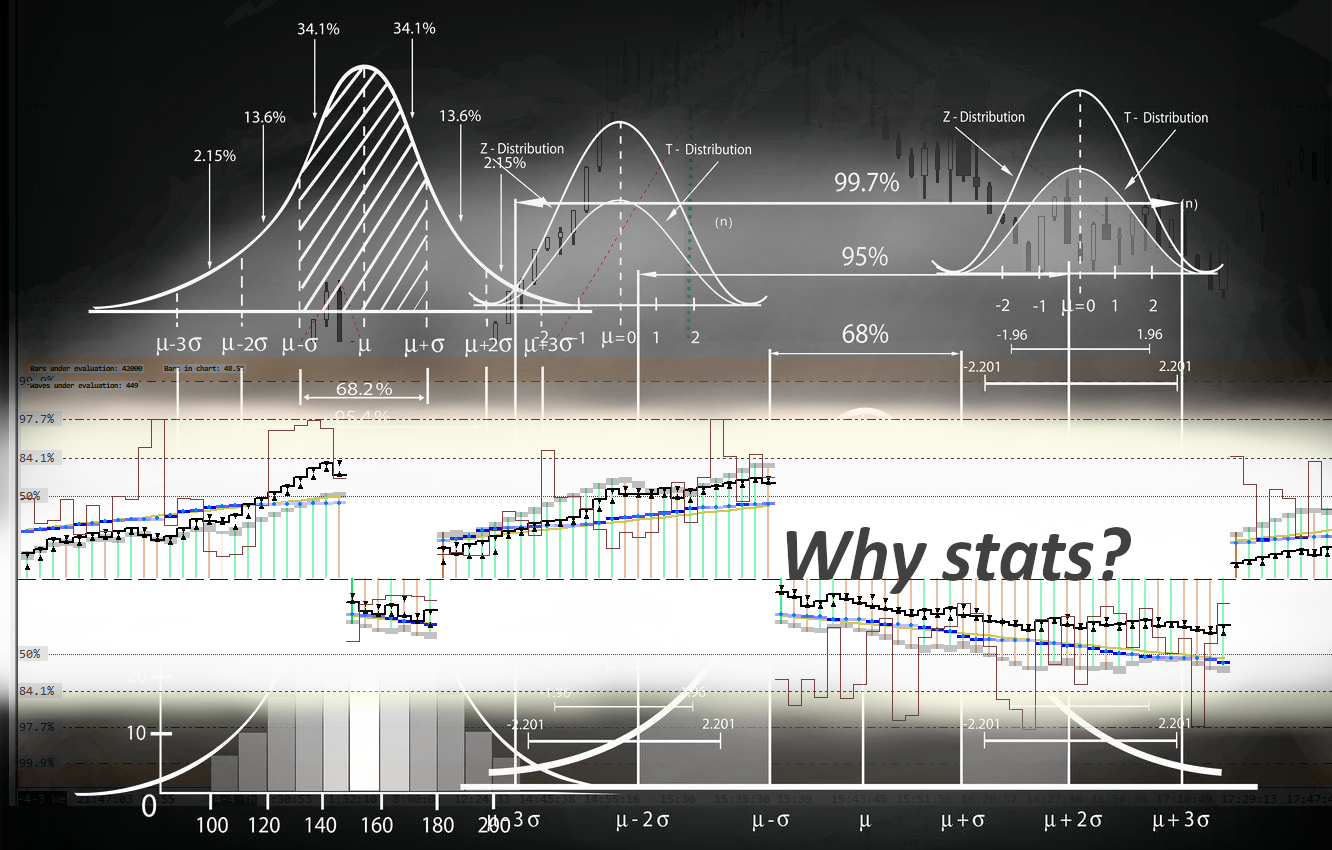
Z-Score = How many standard deviations from the mean.
Z-Score of 0 = Perfectly average
Z-Score of +1 = One standard deviation above average (happens ~32% of the time)
Z-Score of +2 = Two standard deviations above average (happens ~5% of the time)
Z-Score of +3 = Three standard deviations above average (happens ~0.3% of the time)
When our tools show: "Delta Z-Score: +2.3"
That means: This delta reading is 2.3 standard deviations above normal (eg. based on 250,000+ bars of history as per user setting).
Probability Zones: Visual representation of Z-scores on your chart.
Green zone = Normal behavior (happens frequently)
Yellow zone = Somewhat unusual (1-2 SD)
Red zone = Highly unusual (2+ SD)
You're not memorizing formulas. You're reading gauges. Simple to interpret. Rigorous underneath. Same reason they use gauges in your car.
Why We Built Statistical Tools
Most order flow tools show you what's happening.
We show you if what's happening is normal or unusual.
That's the edge.
Institutions use statistical models. You should too.
We follow the same concepts, but accessible to retail traders.
Next: Understand our pricing philosophy and why subscriptions align incentives.
Previous: Why target adept traders?